RAG vs Fine-Tuning: Which One Should You Choose?
Complete guide to choosing between RAG and Fine-Tuning for your LLM application. Real world examples, cost comparison and decision framework included.
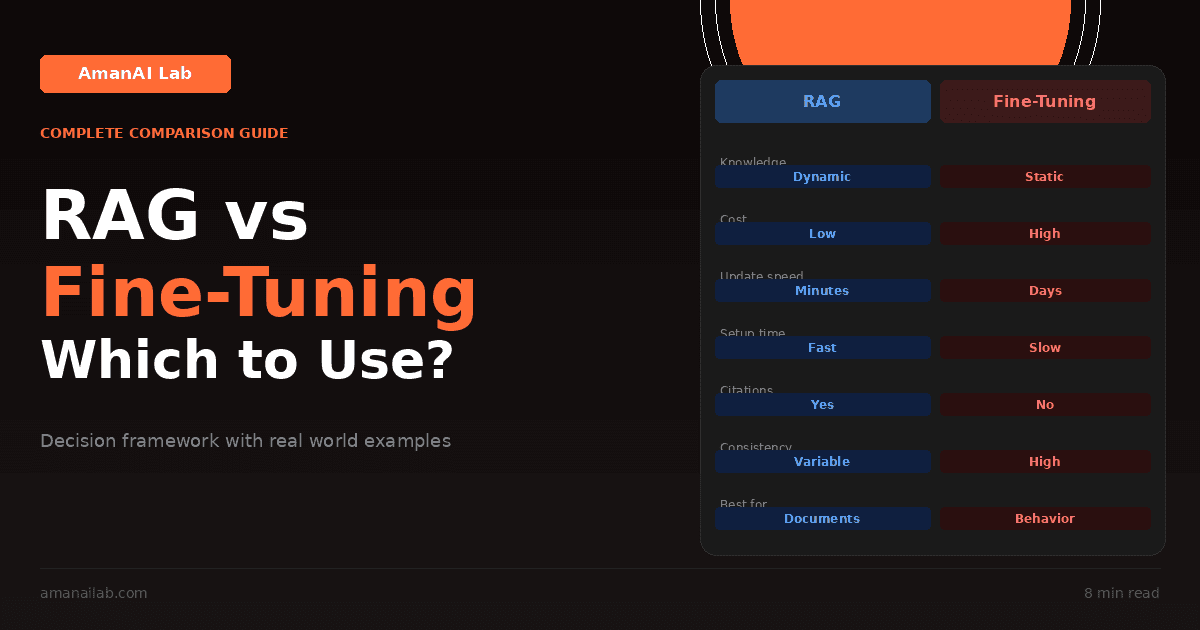
One of the most common questions in
every AI interview and every production
AI project is this: should I use RAG
or fine-tuning?
Both improve LLM performance but in
completely different ways. This guide
gives you a clear decision framework.
What is RAG in Simple Terms?
RAG retrieves relevant information
at query time and provides it as
context to the LLM.
Think of it like an open book exam.
The LLM can look up information
when needed instead of memorizing
everything during training.
The LLM itself does not change.
Only the information it receives changes.
What is Fine-Tuning in Simple Terms?
Fine-tuning further trains a pre-trained
LLM on your own dataset to change its
behavior, style or domain knowledge.
Think of it like teaching someone
new skills through practice. The
knowledge becomes part of them.
The LLM weights are permanently updated.
The model itself changes.
Key Differences
Knowledge Type
RAG is best for dynamic knowledge:
Company documents that update regularly
Product catalogs that change often
News and current events
Customer support knowledge base
Fine-tuning is best for static knowledge:
Medical terminology and procedures
Legal language and formats
Company writing style and tone
Specialized domain vocabulary
Cost Comparison
RAG cost:
No training cost
Vector database hosting cost
Extra tokens per query for context
Easy to update knowledge instantly
Fine-tuning cost:
GPU training cost can be high
Need high quality training data
Takes time to prepare and train
Must retrain when knowledge changes
For most use cases RAG is significantly
cheaper than fine-tuning.
When Things Go Wrong
RAG failures:
Retrieval finds wrong documents
Chunking strategy loses context
Embedding model misses semantic meaning
Context window too small for all chunks
Fine-tuning failures:
Catastrophic forgetting of general knowledge
Overfitting to training data
Hallucination with high confidence
Hard to debug and fix quickly
Update Speed
RAG: update knowledge in minutes.
Just add new documents to vector database.
No retraining needed.
Fine-tuning: update knowledge takes days.
Must prepare new training data.
Must retrain the model.
Must evaluate and deploy new version.
Decision Framework
Use RAG when:
Knowledge changes frequently
You need to cite sources
You have large document collections
Budget is limited
You need to get started quickly
You want easy knowledge updates
Use fine-tuning when:
You need consistent output format
Domain vocabulary is very specialized
Model needs specific persona or tone
Latency requirements are very strict
Prompt engineering cannot achieve results
Knowledge is stable and rarely changes
Use both together when:
You need domain-specific behavior AND
up-to-date factual knowledgeFine-tune for style and tone
RAG for knowledge and facts
This combination gives best results
Real World Examples
Example 1: Customer Support Chatbot
Best approach: RAG
Reasons:
Product information changes constantly
Need to cite specific policy documents
Easy to update when policies change
No need for special writing style
Example 2: Medical Diagnosis Assistant
Best approach: Fine-tuning plus RAG
Reasons:
Needs medical terminology and reasoning
Must follow specific clinical format
Also needs current medical literature
Fine-tune for domain, RAG for knowledge
Example 3: Code Generation Tool
Best approach: Fine-tuning
Reasons:
Need consistent code style
Specific framework patterns
Output format is very structured
Knowledge is relatively stable
Example 4: Legal Document Analyzer
Best approach: RAG
Reasons:
Laws and regulations change
Must reference specific documents
Need source citations
Large document collections
Cost Reality Check
Let me give you real numbers.
RAG system monthly cost for 1000 users:
Vector database: ₹1,500/month
LLM API calls: ₹3,000/month
Embedding API: ₹500/month
Total: ₹5,000/month
Fine-tuning one-time cost:
Data preparation: 40 hours of work
Training on A100 GPU: ₹8,000-₹25,000
Evaluation and testing: 20 hours
Total: ₹15,000-₹40,000 upfront
For most startups and developers RAG
is the right starting point. Add
fine-tuning only when RAG is not
sufficient for your use case.
My Recommendation
Start with RAG. Always.
RAG is faster to build, cheaper to run
and easier to update. It handles 80
percent of use cases perfectly.
Add fine-tuning only when you find that:
RAG responses are inconsistent
Domain terminology confuses the model
Output format is wrong despite prompting
Latency is too high due to large context
In 2 years of building production AI
systems I have found that most projects
succeed with good RAG and prompt
engineering alone. Fine-tuning is
for the remaining 20 percent.
Quick Reference Card
RAG: Dynamic knowledge, cheap, fast
to update, cites sources, easy to debug
Fine-tuning: Static knowledge, expensive,
slow to update, consistent behavior,
hard to debug
Both: Best of both worlds, most complex
use cases, enterprise applications
Conclusion
The RAG vs fine-tuning question does
not have one right answer. It depends
entirely on your specific use case.
Use this guide as your decision framework.
Start with RAG. Add fine-tuning if needed.
Download our free RAG Complete Guide
and LLM Fine-Tuning Guide at
amanailab.com/resources for quick
reference during your next project.
Enjoyed this article?
Join 500+ AI developers getting weekly tips, news and resources from AmanAI Lab.
No spam. Unsubscribe anytime.
More in General
Discussion
Sign in to comment →Join the discussion
Sign in with your AmanAI Lab account — it takes 30 seconds.