The Sentinel Shift: Why AI is the Only Firewall Left in 2026
An in-depth look at how AI agents and predictive analytics are redefining the digital frontlines, featuring real-world case studies of autonomous defense.
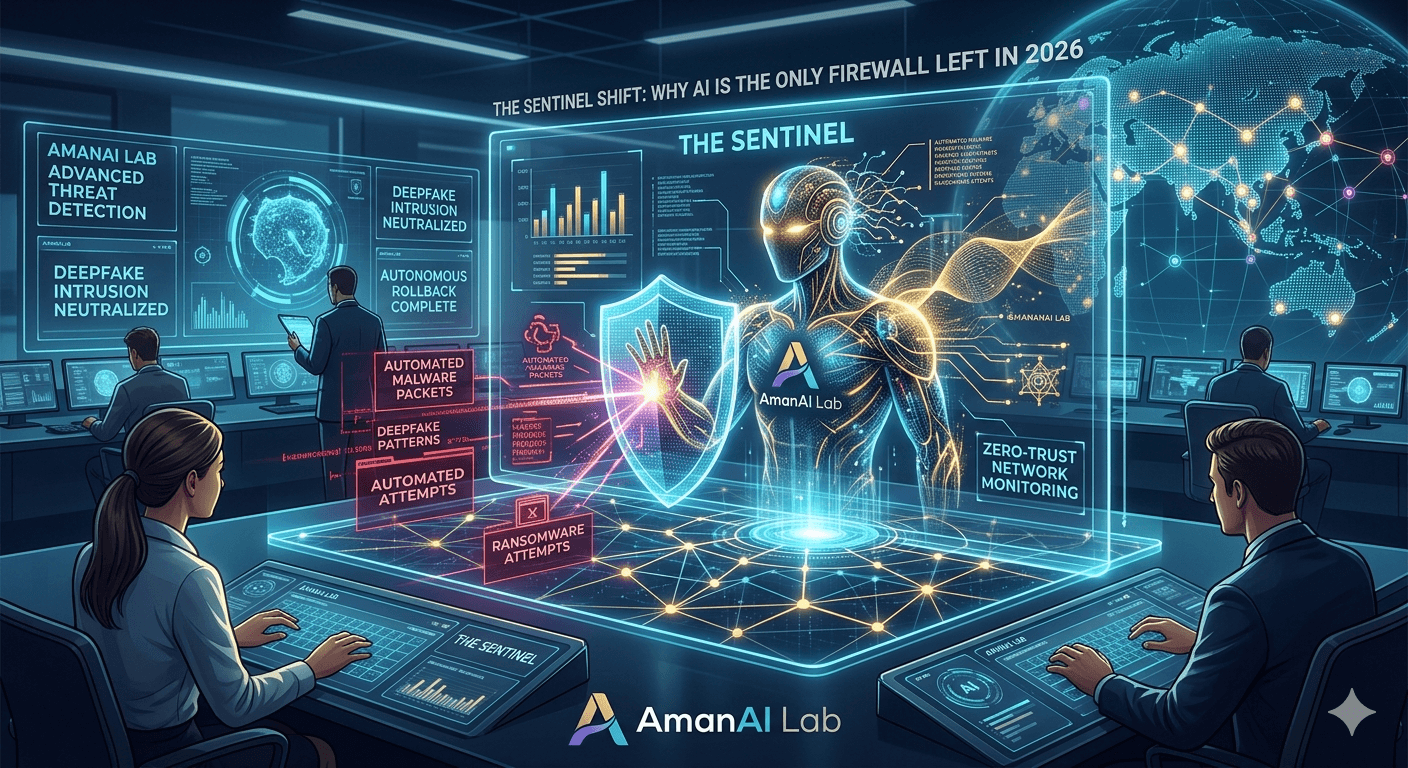
Introduction: The Death of the "Reactive" Era
For decades, cybersecurity was a game of "Whack-A-Mole." An attacker found a hole, we patched it. An attacker sent a phishing link, we trained the employees. But in 2026, the moles have jetpacks.
With the rise of Autonomous Attack Agents capable of launching 10,000 personalized phishing attempts per second, the human-in-the-loop model has officially broken. At AmanAI Lab, we’ve been tracking this transition: we are moving away from static firewalls toward a Dynamic Truth Layer—where AI doesn't just help the analyst; it is the analyst.
The Dual-Edged Sword: AI vs. AI
In today's landscape, the battlefield is entirely algorithmic. Attackers use LLMs to automate reconnaissance and craft "malware-free" intrusions that live off the land (using legitimate tools like PowerShell or Python to evade detection).
Defense vs. Offense: 2026 Comparison
FeatureOffense (The AI Predator)Defense (The AI Sentinel)SpeedSub-second vulnerability scanningMillisecond intrusion isolationTacticsPolymorphic code that changes every minuteBehavioral baselining (UEBA)ScaleGlobal, automated "Spray and Pray"Predictive patching and virtual segmentation
Real-Life Example: The "Deepfake" Recruitment Crisis
One of the most chilling trends we’ve seen recently is the use of Generative AI in Remote Work Fraud.
In early 2026, a series of high-profile tech firms were targeted by sophisticated operatives using real-time AI voice and video cloning. These "applicants" successfully bypassed video interviews, secured high-level engineering roles, and gained access to sensitive repositories.
The Lesson: Traditional Identity and Access Management (IAM) is no longer enough. If an AI can mimic your face and voice, your biometric security is just another data point to be spoofed.
We now require Continuous Authentication, where AI monitors typing rhythm, network pathing, and command-line habits to ensure you are who you say you are throughout the session.
Case Study: How Autonomous Rollback Saved a Global Logistics Firm
The Incident
In February 2026, a major logistics provider was hit by a zero-day ransomware strain that utilized a previously unknown vulnerability in an IoT gateway. The malware was designed to encrypt the firm’s entire shipping database within 15 minutes.
The AI Intervention
The firm had deployed an AI-driven Endpoint Detection and Response (EDR) system. Here is how the AI handled the attack without human intervention:
Detection (0–2 Seconds): The AI noticed a sudden, anomalous spike in file-renaming activity and an outbound connection to an unrecognized C2 (Command & Control) server.
Containment (5 Seconds): Rather than waiting for an admin, the AI agent automatically isolated the infected server from the rest of the network.
Autonomous Rollback (120 Seconds): Using Shadow Copy integration, the AI identified the exactly affected files and rolled them back to their pre-encrypted state.
The Result
Downtime: Zero
Data Loss: Negligible
Human Effort: The security team only learned about the attack when they received a "Threat Neutralized" report in their morning briefing.
The AmanAI Lab Recommendation: Building Your Sentinel
To survive the 2026 threat landscape, organizations must pivot their strategy. Here are the three pillars we recommend:
Shift to "Assume Compromise": Stop trying to keep everyone out. Start building systems that can detect and isolate an intruder in seconds using micro-segmentation.
Deploy "Virtual Patching": Tools like Cisco Hypershield now allow you to shield vulnerable workloads automatically until a permanent patch is tested. This closes the "Exploit Gap."
Audit Your AI Supply Chain: Your defense is only as good as the models it's built on. Ensure your security AI isn't susceptible to prompt injection or data poisoning.
Final Thought
Cybersecurity used to be about building a bigger wall. Today, it's about building a smarter brain. At AmanAI Lab, we believe the future of security isn't human or machine—it's human oversight of machine autonomy.
Quick Checklist for CISOs
Is your SOC using AI-driven alert triaging? (Reduces fatigue by 70%+)
Do you have a "Deepfake Response Plan" for your HR and Finance teams?
Are your AI models protected against adversarial manipulation?
What’s your biggest challenge in the AI-Cyber era? Let’s discuss in the comments below.
Enjoyed this article?
Join 500+ AI developers getting weekly tips, news and resources from AmanAI Lab.
No spam. Unsubscribe anytime.
More in General
Discussion
Sign in to comment →Join the discussion
Sign in with your AmanAI Lab account — it takes 30 seconds.