Top 10 Agentic AI Interview Questions Answered
Complete answers to the most asked Agentic AI interview questions. Covers agents, ReAct, multi-agent systems, memory and frameworks. Perfect for AI Engineer interviews.
Agentic AI is the hottest topic in
every AI interview right now. Every
company building AI products is moving
towards agents. Here are the top 10
questions you will face and exactly
how to answer them.
1. What is an AI Agent?
An AI agent is an LLM that can perceive
its environment, reason about what to do,
take actions using tools and work towards
a goal autonomously.
Unlike a simple LLM that just generates
text, an agent can:
Call APIs and external services
Search the web for information
Write and execute code
Read and write files
Make decisions in a loop
Work towards a goal step by step
The key difference is autonomy. A chatbot
responds. An agent acts.
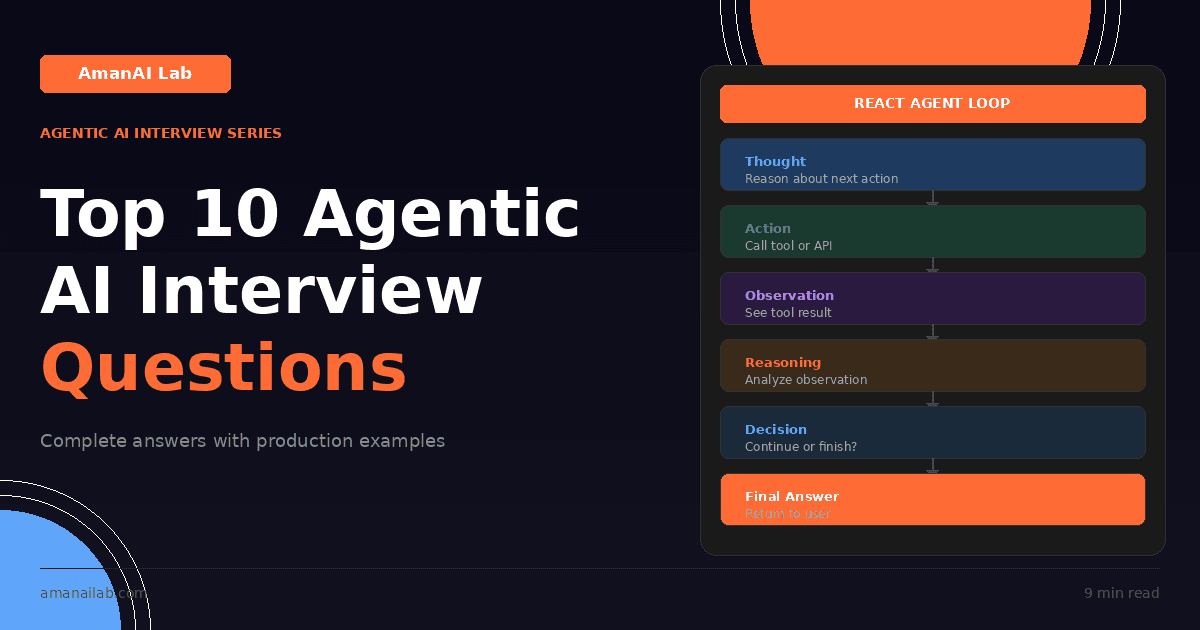
2. Explain the ReAct Pattern
ReAct stands for Reason and Act.
It is the most common agent pattern
and works in a loop:
Step 1: Thought — agent reasons about
what to do next
Step 2: Action — agent calls a tool
Step 3: Observation — agent sees result
Step 4: Repeat until goal is achieved
Example:
Thought: I need to find the current
price of Bitcoin
Action: search("Bitcoin price today")
Observation: Bitcoin is $65,000
Thought: I have the answer now
Final Answer: Bitcoin is $65,000
Always set a max iterations limit
to prevent infinite loops. 10-15
iterations is standard.
3. What is the Difference Between
Single Agent and Multi-Agent Systems?
Single agent uses one LLM with tools
for simple tasks. Good for:
Straightforward workflows
Tasks that do not need parallel work
Simple question answering with tools
Multi-agent uses multiple specialized
agents that collaborate. Good for:
Complex tasks needing parallel work
Tasks requiring different expertise
Long running workflows
In multi-agent systems an orchestrator
agent breaks down the goal and assigns
tasks to specialist agents. Each specialist
focuses on one domain like research,
writing or coding.
Multi-agent is more powerful but harder
to debug and more expensive.
4. What Types of Memory Do AI Agents Have?
Agents have four memory types:
Sensory memory: raw input being processed
right now like the current message.
Short-term memory: the context window.
Temporary, lost after the session ends.
Long-term memory: vector database storing
past interactions and knowledge. Persists
across sessions. Retrieved when relevant.
Episodic memory: specific past experiences
stored and retrieved based on similarity
to current situation.
Production agents combine short-term
context with long-term vector database
recall for the best results.
5. What Tools Can AI Agents Use?
Agents can use any tool you give them.
Common tools include:
Search tools: web search, document search,
database queries
Code tools: Python REPL, bash execution,
code interpreter
API tools: REST APIs, weather, news,
calendar, email
File tools: read files, write files,
create documents
Memory tools: save to memory, recall
from memory
The key is defining tools clearly with
name, description and input schema.
The LLM decides which tool to call
based on the description.
6. What is LangGraph and Why Use It?
LangGraph is a framework for building
stateful multi-agent applications using
a graph-based execution model.
Unlike simple chains LangGraph supports:
Cycles and loops in agent workflows
Branching based on conditions
Persistent state across steps
Human in the loop interrupts
Parallel execution of multiple agents
Use LangGraph when your agent needs
to loop, branch or maintain complex
state. Use simple LangChain for
straightforward linear workflows.
7. What is Human in the Loop?
Human in the loop means pausing agent
execution at critical decision points
to get human approval before proceeding.
Examples of when to pause:
Before sending an email
Before deleting data
Before making a purchase
When confidence is low
Before taking irreversible actions
Implemented using interrupts in LangGraph
or checkpoints in other frameworks.
Essential for production agents handling
consequential actions. Never let agents
take irreversible actions without human
confirmation.
8. How Do You Handle Agent Failures?
Agent failures happen when:
Tool calls fail or timeout
LLM returns malformed output
Max iterations reached
Infinite loops occur
Best practices for handling failures:
Always set max iterations limit.
Wrap tool calls in try catch blocks.
Implement retry logic with exponential backoff.
Have a graceful fallback response.
Log all failures with full context.
Alert on high failure rates.
Never let agents fail silently.
9. What is the Difference Between
CrewAI and LangGraph?
CrewAI organizes agents as a crew with
defined roles, goals and backstories.
Agents collaborate through sequential
or hierarchical processes. Best for
role-based workflows like research
then writing then review.
LangGraph uses a graph model with nodes
and edges. More flexible and lower level.
Supports complex state machines, cycles
and custom orchestration logic.
Use CrewAI for quick role-based workflows.
Use LangGraph for complex stateful agents
needing fine-grained control.
10. How Would You Design a Production
AI Agent System?
A production agent system needs these layers:
API layer: rate limiting, authentication,
request validation
Orchestration layer: LangGraph or CrewAI
managing agent workflow
Tool layer: well-defined tools with
error handling and timeouts
Memory layer: Redis for short-term,
vector DB for long-term
Safety layer: output validation, content
filtering, action approval
Observability layer: LangSmith for tracing,
custom metrics for monitoring
Each layer is independent and can be
scaled separately. Always start simple
with single agent and add complexity
only when needed.
Conclusion
Agentic AI is the future of AI engineering.
Master these 10 concepts and you will
stand out in every AI interview.
The best way to learn agents is to build one.
Start with a simple ReAct agent using
LangChain and web search tool. Then
add memory and more tools gradually.
Practice with our free AI Interview
Simulator at amanailab.com/interviewwhich covers all these agent topics.
Download our free Agentic AI Complete
Guide at amanailab.com/resources.
Enjoyed this article?
Join 500+ AI developers getting weekly tips, news and resources from AmanAI Lab.
No spam. Unsubscribe anytime.
More in Interview Prep
Discussion
Sign in to comment →Join the discussion
Sign in with your AmanAI Lab account — it takes 30 seconds.